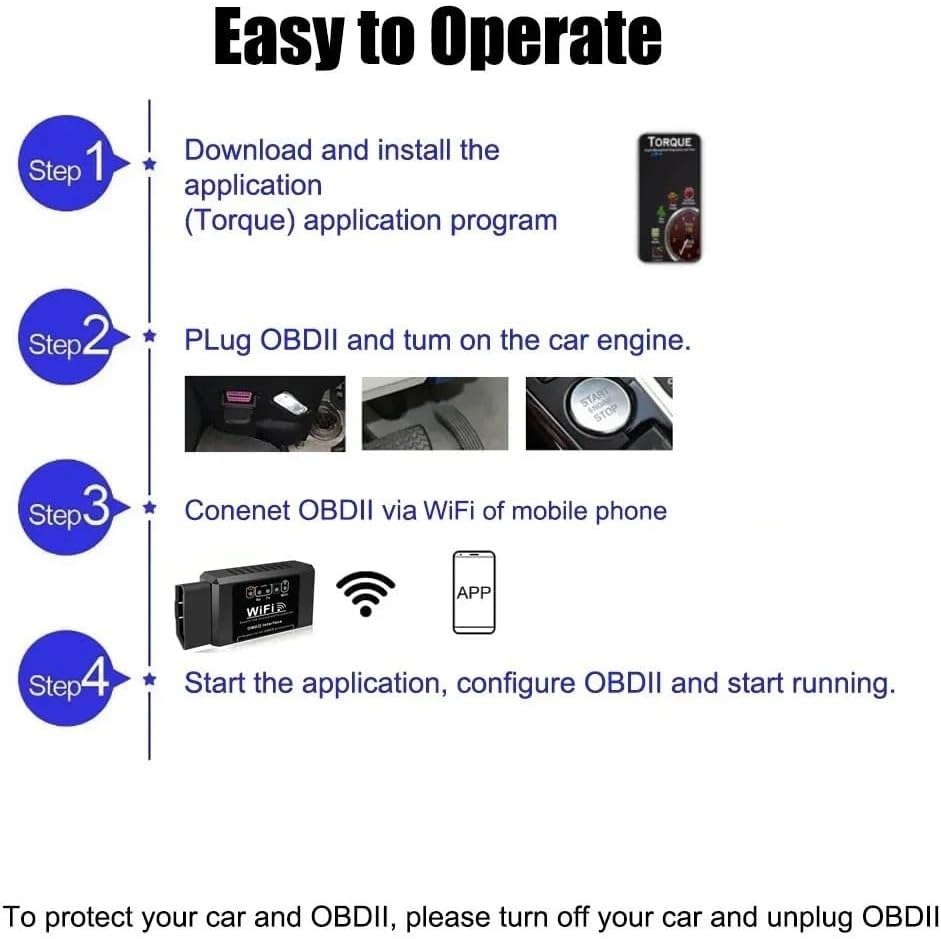
- Wi-Fi connection
- Works with iPhone, Android
The generic ELM327 Wi-Fi adapter is the no-frills way to read a check-engine code on a phone. It broadcasts its own small Wi-Fi network, so iPhones and Android phones can both use it with apps like Car Scanner and Torque.
A warning lamp on the highway raises one question: can I keep driving? A Wi-Fi ELM327 in the glovebox answers it in a couple of minutes. Pull over, plug it in, and the phone shows the trouble code and what the car was doing when it was stored.
That is the job this adapter does well. It reads and clears codes, shows live sensor data and lets you judge whether a fault is a loose fuel cap or something that needs a tow. Keeping an eye on the sensors also helps you spot habits that are hard on the car.
Wi-Fi is the reason iPhones can use it at all. Apple does not let ordinary apps talk to Classic Bluetooth adapters, so cheap Bluetooth ELM327s never show up on an iPhone. A Wi-Fi adapter sidesteps that by acting as a tiny network the phone can join.
It needs no laptop and no cables. The adapter is small and light, so it lives in a door pocket until a light appears. The ELM327 app guide lists free and paid apps for both phones, and the step-by-step connection guide walks through a first scan.
| Spec | Value |
|---|---|
| Brand (lead model) | ULTRAOBD |
| Model | WIFI OBD |
| Link type | Wi-Fi only |
| Bluetooth | No |
| iPhone / iPad | Yes, with Wi-Fi OBD apps |
| Android | Yes |
| Suggested apps | Torque (Android); Car Scanner, OBD Mate (iPhone) |
| Functions | Read and clear trouble codes, live sensor data |
| Vehicles | 12V petrol and diesel OBD2 vehicles |
| FORScan | Not supported |
| Ford-family programming | Not supported |
| Motorcycles | Not supported |
| Laptop needed | No; phone or tablet |
| Power | Car's OBD port |
| Dimensions | 3.5 x 1.8 x 1 in |
The first connection takes a few minutes; after that the phone remembers it. Most generic adapters broadcast a network with a name like WiFi_OBDII, with no password. The card in the box gives the exact name and address for your unit, so keep it handy.
Those numbers are typical, not universal. If the app cannot connect, check the card, or use an app that scans the network to find the adapter. Once one setup works, write the numbers inside the manual cover.
The versions vary in small ways. Some carry a v1.5 label and others v2.1 on a PIC18F25K80 board; the number printed on a clone says little about quality, and the v1.5 versus v2.1 comparison explains why. The iCar2- and iCar3-style versions borrow Vgate's names but are not Vgate products.
Every Wi-Fi adapter shares one catch. Once the phone joins the adapter's network, it may try to send all its traffic that way, and that network leads nowhere but the car. Navigation, streaming and messages can stall while the OBD app is open.
Phones handle this differently, and the fixes work with varying success:
Wireless CarPlay and wireless Android Auto add a second clash. They use the phone's Wi-Fi to reach the car's screen, so on many cars the phone cannot hold the head unit and a Wi-Fi OBD adapter at the same time. Wired CarPlay avoids the conflict.
Parked at the roadside reading a code, none of this matters much. It becomes a real nuisance if you want live gauges on a long drive with navigation running. In that case a Bluetooth LE adapter is the better tool, because it leaves the phone's Wi-Fi alone.
Battery use is the other trade-off. Wi-Fi radios draw more power than Bluetooth LE when idle, and a generic unit may have no sleep mode at all. Unplug it after each use on a car that sits. The Wi-Fi adapter guide goes deeper on both problems.
The lead model is unusually clear about what it will not do, and it repeats it in capitals. It is Wi-Fi only, it does not support Bluetooth, it does not support FORScan, and it is not for motorcycles. It also cannot program Ford, Lincoln, Mercury or Mazda cars.
Those limits shape who should buy it. For generic codes and live data on a phone, it is the cheapest route onto an iPhone. For anything that writes to the car, it is the wrong tool.
Diesel owners get the same generic functions as petrol owners, provided the vehicle runs on 12V. Heavy trucks on 24V systems are outside its range, and so are cars older than the OBD2 standard. Electric and hybrid cars answer generic requests to varying degrees, depending on the maker and the app you use.
| Your plan | Generic Wi-Fi | Better fit |
|---|---|---|
| Read a check-engine code on an iPhone | Yes | — |
| Live data with navigation running | Awkward | Veepeak OBDCheck BLE |
| FORScan on a Ford | No | vLinker FS USB |
| Leave plugged in with sleep mode | Not stated | Vgate iCar Pro Wi-Fi |
| BMW coding | No | A BimmerCode-certified Bluetooth adapter |
Three things to settle at home first:
If you like the Wi-Fi approach but want a branded unit with firmware updates and battery saving, Vgate's iCar Pro Wi-Fi is the step up. If you only need an iPhone to see the car, a BLE adapter does it with less fuss.
Yes. The phone joins the adapter's Wi-Fi network and apps like Car Scanner and OBD Mate connect over it.
Many generic units use 192.168.0.10 and port 35000, but check the card in the box, as defaults vary.
The phone may route traffic through the adapter's network, which has no internet. Leaving the router field blank or accepting the stay-connected prompt often helps.
No. The maker states it does not support FORScan or Ford-family programming.
No. It is not supported on motorcycles.