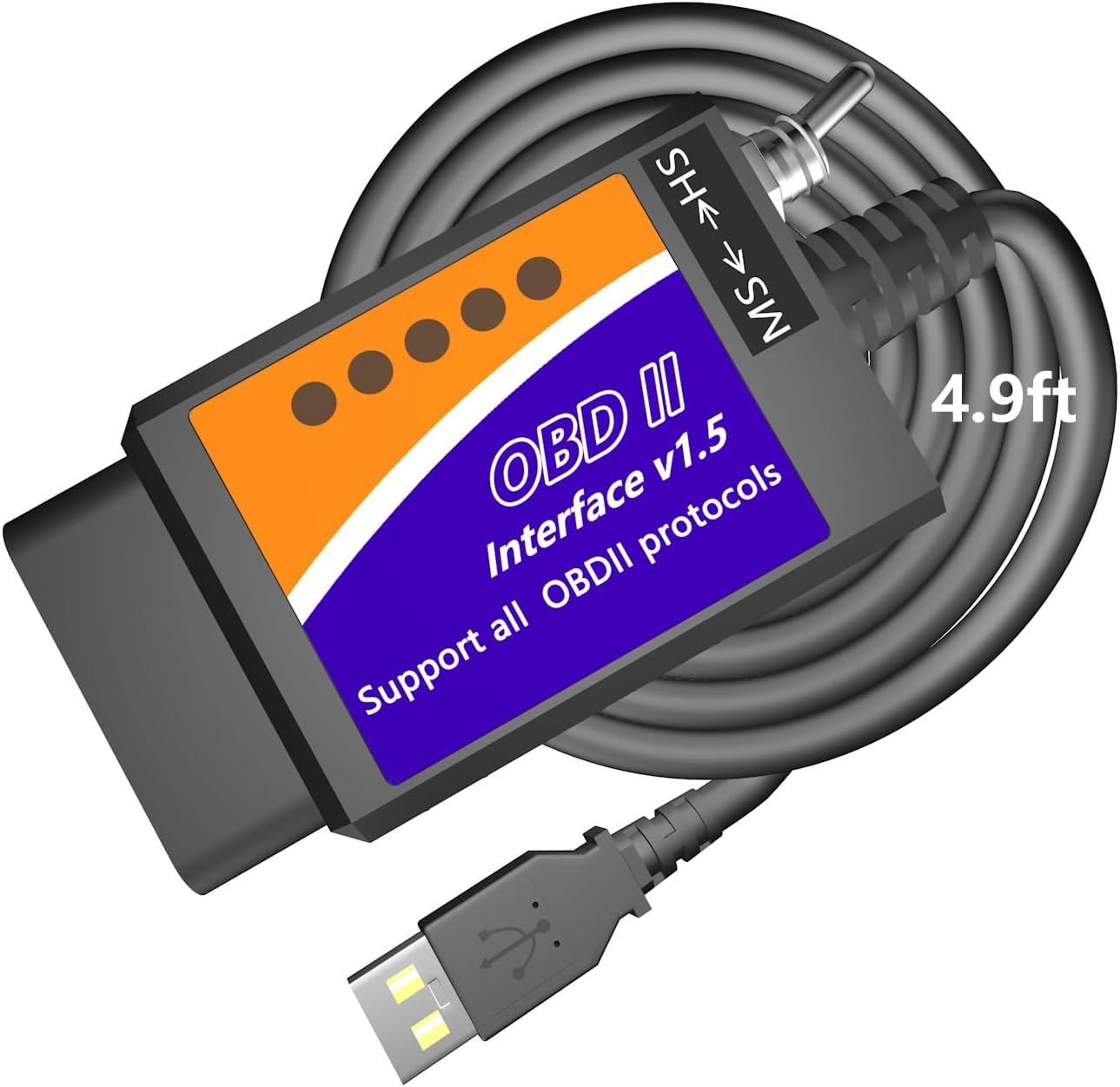
- USB cable for laptops
- Works with Windows
- FORScan-ready (HS/MS-CAN)
The classic budget route into Ford module settings: a v1.5 ELM327 USB cable with a manual HS-CAN/MS-CAN toggle, a CH340-type USB chip on most builds and Windows software such as FORScan, ELMconfig and FoCCCus.
Plug a plain ELM327 into a Ford and it reads engine codes happily, then goes quiet when you ask for the instrument cluster or the radio. Those modules sit on a second network, medium-speed CAN, on different pins of the port. The small toggle on this cable moves the connection across so the same chip can reach them.
That one switch is what turns an ordinary USB ELM327 into a Ford tool. With FORScan or ELMconfig open on a Windows laptop, you can read and clear codes in every module, watch live data and change settings the car already supports.
The lead model names a long wish list of changes owners make, provided the car has the matching modules:
Coverage runs across Ford, Lincoln, Mercury and Mazda from 1996, and the cable works as a normal OBD2 reader on other cars. The protocol list includes the older J1850 PWM used by late-1990s Fords as well as HS-CAN, MS-CAN, HS-CAN2 and HS-CAN3.
Treat the switch position as part of the job. Leave it on HS for everyday scanning and move it only when FORScan asks, or MS-CAN modules will seem to vanish. The FORScan guide explains which modules live on which bus.
| Spec | Value |
|---|---|
| Brand (lead model) | OBDResource |
| Model | FORD327 |
| Link type | USB, wired |
| Hardware | ELM327 v1.5 type |
| USB-serial chip | CH340T (lead model); FT232RL FTDI on some versions |
| Driver | CH340T USB driver, installed before first use |
| Bus switch | Manual HS-CAN / MS-CAN toggle |
| Protocols | All OBD2 protocols, plus J1850 PWM, HS-CAN, MS-CAN, HS-CAN2, HS-CAN3 |
| Computer | Windows XP, Vista, 7, 8, 10; 32- and 64-bit |
| iPhone / Android | No |
| Software | FORScan, ELMconfig, FF2, FoCCCus, ScanMaster |
| Vehicles | Ford, Lincoln, Mercury, Mazda from 1996; generic OBD2 on other cars |
| Named Ford models | F-150 to F-450, Ranger, Transit, Mustang, Explorer, Edge, Fusion, C-Max, S-Max, Kuga, Mondeo |
| Not for | Trailers and semi-trailers |
| Weight | 100 g |
These cables come from many workshops under many names, and they are not identical. The part that differs most is the USB-to-serial chip, which makes the cable look like a COM port to Windows. The lead OBDResource cable uses a CH340T; a few versions, such as the AntiBreak build, name an FTDI chip instead.
| Point | CH340-type cable | FTDI FT232RL cable |
|---|---|---|
| Driver | CH340 package from WCH | FTDI VCP driver |
| Windows name | USB-SERIAL CH340 | USB Serial Port |
| Latency tuning | Not usually exposed | Adjustable in port settings |
| Counterfeit risk | Low | Copies of the FT232 exist |
Both chips read codes and write configuration well. FTDI cables let you lower the port's latency timer, which some FORScan users prefer for snappier replies. CH340 cables cost less and work fine for the occasional tweak.
The versions differ in other ways too. Most carry the HS/MS-CAN toggle. A handful, such as the FT232RL cable with a PIC18F25K80 v1.4 board and the plain CERRXIAN lead, do not name a switch at all, which makes them general OBD2 cables rather than Ford tools. The VINTscan VINT-TT55502 is a separate Windows design sold under its own name.
The v1.5 versus v2.1 comparison explains why a v1.5 label is the one Ford owners look for.
The maker says it plainly: this is a professional tool, not plug-and-play, and the driver goes on before the cable goes in. A new cable that seems dead is almost always a missing driver. Sort it out at the desk, because the laptop side works without the car connected.
If the port shows a yellow warning triangle, remove the device, reinstall the driver and replug. Newer Windows versions insist on signed drivers, which the chip makers supply.
Most clone ELM327 cables talk at 38,400 baud, and the software usually finds that on its own. You can test the link by hand with a few AT commands from a terminal; the ELM327 commands page lists the useful ones. The USB guide covers the driver story in more depth.
A switched generic cable reaches the same modules as adapters costing several times more. What it gives up is convenience, speed and the steadiness that matters on long writes. For a few settings changed once, that trade is often fine.
| Adapter | Switching | Best for |
|---|---|---|
| Generic switched cable | Manual toggle | A few comfort settings, occasional codes |
| MOCATEC USB | Manual toggle, 4.9 ft lead | Toggle cable with room to sit comfortably |
| Vgate vLinker FS USB | Automatic HS/MS | Regular FORScan use, 18V programming support |
| OBDLink EX | Electronic, all buses at once | Module programming and advanced FORScan functions |
Spend more when you plan to reprogram modules, run long service procedures or configure several family cars. The automatic and electronic adapters remove the switch step and move data faster, which shortens every session.
Before any write, connect a battery maintainer and save the original configuration of every module you touch. Whatever cable you use, write down each value next to the one you changed.
A cheap cable also makes a sensible spare. Plenty of owners keep one in the glovebox or garage drawer for reading codes on a road trip, and save the premium adapter for configuration evenings. If the budget cable ever fails at the strain relief, it costs little to replace, and nothing you configured with it is lost, because the settings live in the car's modules.
Versions with the HS/MS-CAN switch work with FORScan on Windows, alongside ELMconfig, FoCCCus and FF2. Versions that name no switch reach only the high-speed bus.
The lead model uses a CH340T chip and needs the CH340 driver from WCH. FTDI versions use the FTDI VCP driver.
On HS for normal scanning. Move it to MS only when FORScan prompts you.
No. It is a USB cable for Windows laptops. Phones need a Bluetooth or Wi-Fi adapter.
Yes, as a normal OBD2 code reader on 1996-or-newer cars, but the Ford-specific features need Ford software.