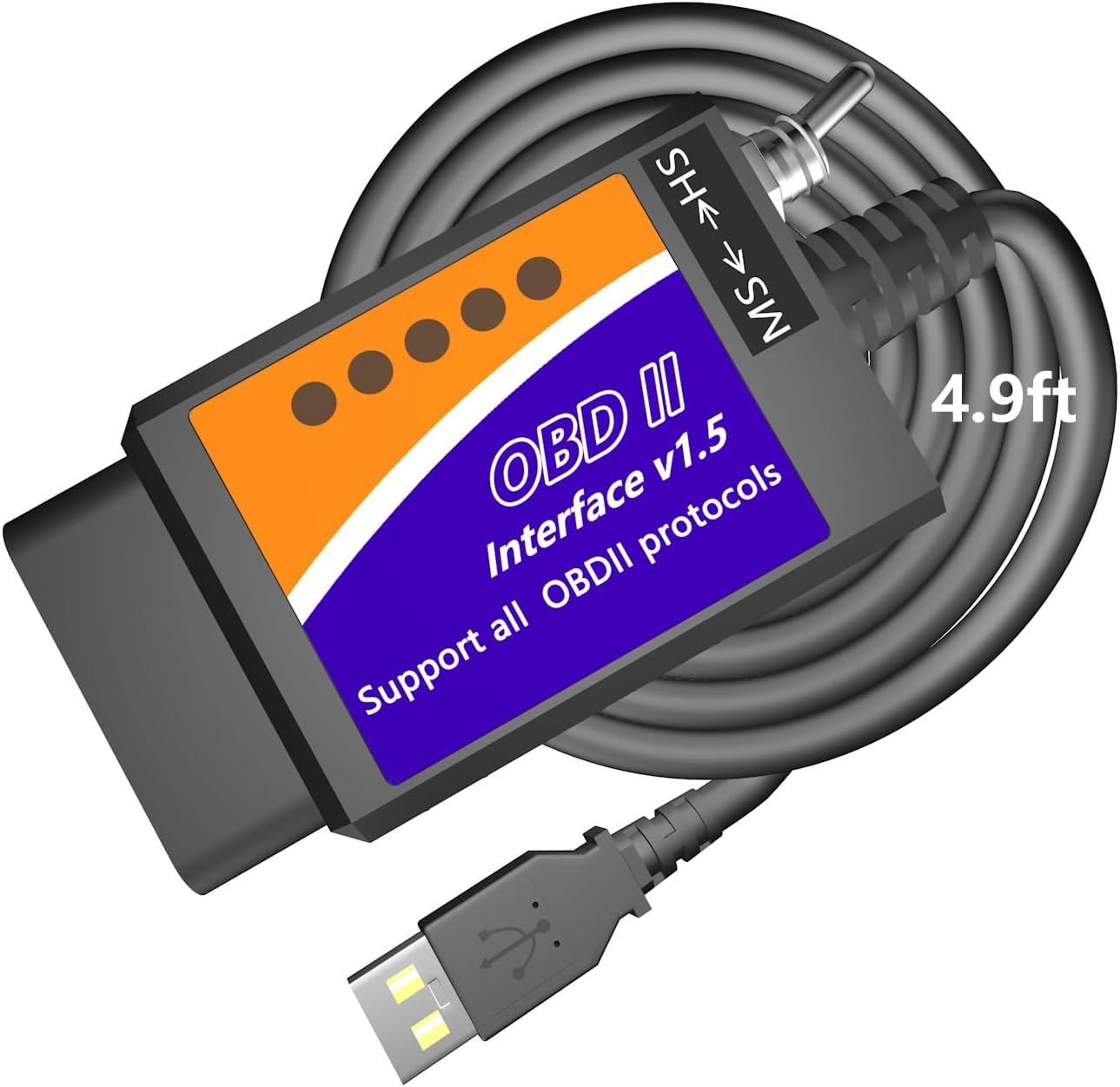
- USB cable for laptops
- Works with Windows
- FORScan-ready (HS/MS-CAN)
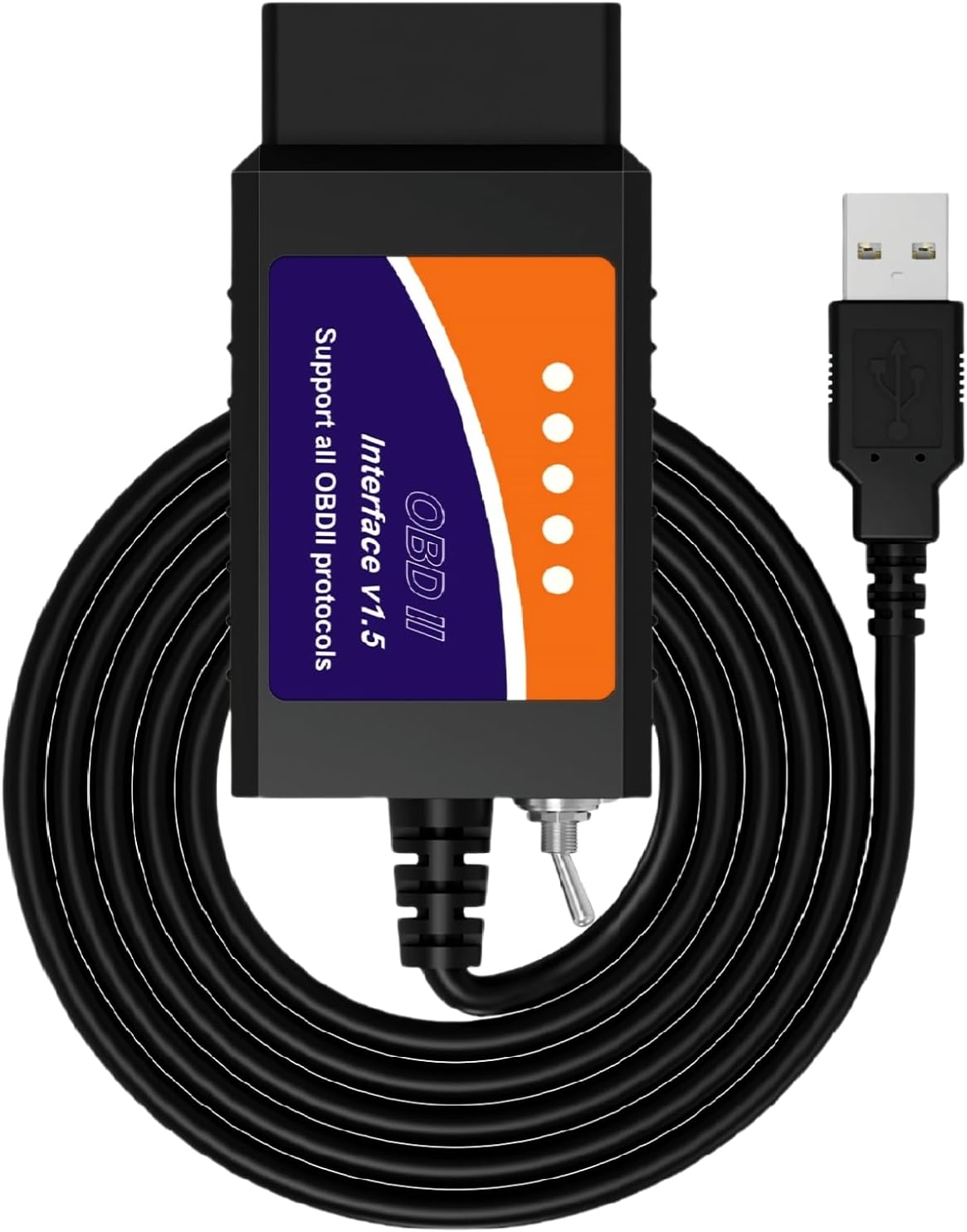
The OBDMonster is a budget ELM327 USB cable for Ford-family cars and F-series trucks: a v1.5 chip, a CH340T USB bridge and an HS/MS-CAN switch, in a manual-toggle version and an automatic one.
Clone ELM327 chips carry a version number, and bigger is not better here. Many cheap boards labelled v2.1 drop commands that older protocols and Ford software rely on. A board labelled v1.5, like the one in the OBDMonster, is the version Ford owners have long reached for.
The OBDMonster pairs that v1.5 chip with the two things a Ford job needs: a USB link to a Windows laptop and a way onto medium-speed CAN. The body and comfort modules of many Fords sit on that second network, and a plain ELM327 never sees them.
With the switch in the right position, OBDMonster names a familiar set of changes, provided your car has the modules for them:
It also works as an ordinary OBD2 code reader on any supported car. The protocol list covers J1850 PWM for late-1990s Fords as well as HS-CAN, MS-CAN, HS-CAN2 and HS-CAN3 for later models.
Coverage notes are specific. OBDMonster names the F-150 and F-250 among Ford trucks, plus the Ranger, Transit, Mustang, Explorer, Edge, Fusion, Mondeo, Kuga, C-Max and S-Max, and claims about 99% of models built after 2000. The v1.5 versus v2.1 comparison explains the version story in full.
| Spec | Value |
|---|---|
| Brand | OBDMonster |
| Model | MS-327 |
| Link type | USB, wired |
| Hardware | ELM327 v1.5 chip |
| USB-serial chip | CH340T |
| Bus switch | Manual HS-CAN / MS-CAN toggle; automatic on version B08SBGVGKC |
| Protocols | All OBD2 protocols, plus J1850 PWM, HS-CAN, MS-CAN, HS-CAN2, HS-CAN3 |
| Computer | Windows XP, Vista, 7, 8, 10, 11 |
| iPhone / Android | No |
| Named software | ELMconfig, FoCCCus, FF2 |
| Vehicles | 12V Ford cars and F-series trucks, Mazda, Lincoln, Mercury |
| Stated coverage | About 99% of models after 2000 and around 92% after 1996 |
| Not supported | 2019+ Mazda3 and CX-30; trailers and semis |
| In the box | OBD2 cable |
OBDMonster sells the cable in two forms. The original has a manual HS/MS-CAN toggle on the body. The second version switches between the two networks automatically and is sold as a Windows-only USB scanner.
| Point | Toggle version | Auto-switch version |
|---|---|---|
| Switching | You flip it when the software asks | Changes over by itself |
| Chip label | v1.5 stated | Not stated |
| Computer | Windows | Windows only |
| Common mistake | Switch left on MS, modules vanish | None from the switch |
The toggle version is the classic design that ELMconfig and FoCCCus guides are written around. You leave the switch on HS for normal scanning and move it to MS when the software prompts you. It works well once you know the routine, and the physical switch gives you a clear picture of which network the cable is talking to at any moment.
Both versions share the same USB approach and the same Windows software. Neither involves a phone app: the programs run on the laptop, and the cable simply carries their requests to the car and the answers back.
The automatic version removes that step, which suits owners who find the switch fiddly or forget where they left it. It does not state its chip label, so buyers who want the v1.5 board by name should pick the toggle cable.
FORScan also accepts switched ELM327 cables of this kind, even though OBDMonster names only ELMconfig, FoCCCus and FF2. The FORScan guide covers how the program handles the switch.
OBDMonster puts it in capitals on the box: install the CH340T USB driver before connecting to the car. The CH340 is a low-cost USB-to-serial bridge that makes the cable appear as a COM port. Without its driver, Windows sees an unknown device and every program reports no adapter.
The CH340 has a mixed reputation from the days of unsigned drivers, but current packages from WCH are signed and install cleanly on Windows 10 and 11. Most driver trouble now comes from discs or download sites offering outdated files.
Mac owners face the same obstacle as with any Ford cable. The cable is fine; ELMconfig, FoCCCus and FF2 are Windows programs. A spare Windows laptop in the garage is the easiest fix, and older machines run these programs happily.
For testing the link by hand, a terminal and a few AT commands tell you whether the chip answers. The ELM327 commands page lists them, and the USB guide compares CH340 and FTDI cables.
Budget cables earn trust by being clear about their limits, and OBDMonster is. It names the 2019-and-newer Mazda3 and CX-30 as not yet supported, and it rules out trailers and semis. It is a 12V tool for cars and light trucks.
The other limits come with the format. It is a USB cable for Windows, so phones and tablets are out. A manual toggle cable also moves data more slowly than an adapter that switches electronically, which matters most on long configuration reads and module programming.
| Your plan | OBDMonster? | Better fit |
|---|---|---|
| Comfort settings on an F-150 | Yes | — |
| Codes on an older Mazda | Yes | — |
| 2019+ Mazda3 or CX-30 | No | Check FORScan's list, then a premium adapter |
| Module programming | Possible, riskier | OBDLink EX |
| Phone use | No | vLinker FS Bluetooth |
Tick these off first:
Treat the first session as a rehearsal. Scan every module, save the original configuration to the laptop and change nothing until that backup is safe. Then make one change at a time, test it on the car and note the old value beside the new one, so any tweak can be undone in a minute.
For a similar cable with a longer lead, the MOCATEC adapter is the nearest rival.
OBDMonster names ELMconfig, FoCCCus and FF2. FORScan accepts switched ELM327 cables of this type too; set the toggle when the program asks.
The CH340T USB driver, installed before you connect to the car.
No. OBDMonster states the 2019-and-newer Mazda3 and CX-30 are not yet supported.
One has a manual HS/MS-CAN toggle and a stated v1.5 chip; the other switches between the networks automatically.
Yes. OBDMonster lists Windows XP through 11.